2026 Augustine Institute Convocation
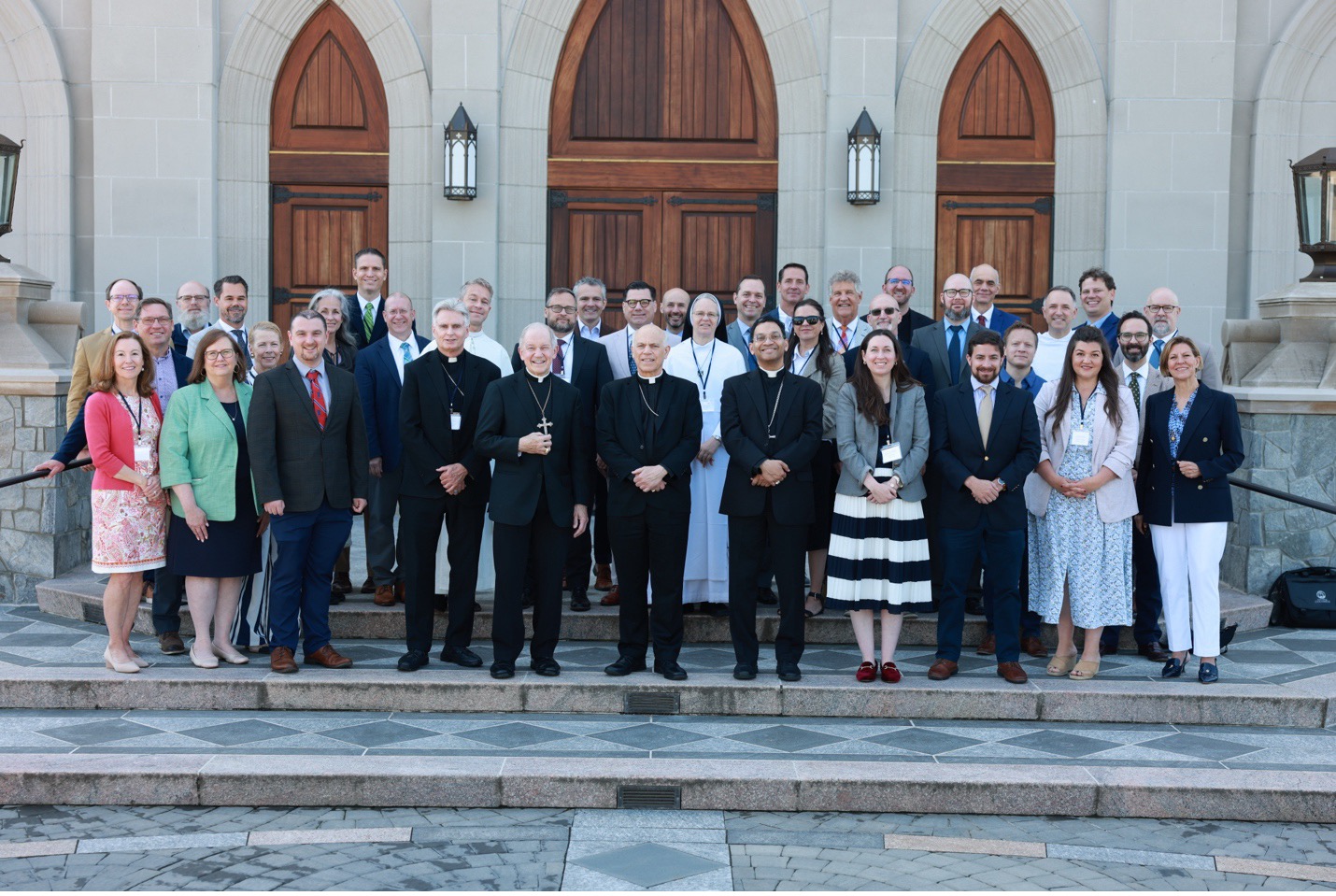
We recently celebrated the start of the 2026–2027 academic year. Please enjoy this address given after the Convocation Mass by our Dean.
Today at Holy Mass [the 21st Sunday in Ordinary Time], we heard of a decisive moment in Simon Peter’s journey of discipleship: his confession of Jesus’s unique divine Sonship and solemn entrustment with the keys of the kingdom of heaven (Matthew 16:13–20). As the ensuing episode makes clear—“Get behind me, Satan!” (16:23)—not to mention the fireside denials looming ahead, Peter still has a long way to go. But he has already come a long way, too. The Gospels let on in various ways that from the beginning our Lord marked out Simon Peter as a leader and spokesman among the disciples. He is named first in every list of the apostles (see Matthew 10:2–4; Mark 3:16–19; Luke 6:14–16; cf. Acts 1:13; 1 Corinthians 15:5). According to Matthew, it is he who asks Jesus on behalf of all the disciples to “explain the parable” of his sharp rebuke of certain Pharisaic traditions (15:1–20, esp. v. 15). In the previous chapter of Matthew, and perhaps most memorably, Simon Peter has already joined Jesus in walking on the sea—for a few steps anyway (14:28–31). Mark 1:29–31 tells us of the Lord entering Simon and Andrew’s house to cure Simon’s mother-in-law of her fever, and, by the beginning of Mark 2, Jesus the Nazarene seems to have made Simon’s house in Capernaum his own “home” (Mark 2:1). We can go further back, to Simon’s call to discipleship. Here it is Luke who underscores Peter’s unique importance.Whereas Matthew and Mark tell us of Jesus calling Simon and Andrew to abandon their nets and become fishers of men, Luke speaks only of Simon, and expands the other Synoptists’ terse accounts with the report of a miraculous catch and Simon’s response of reverent dread (Luke 5:1–11; compare Matthew 4:18–20; Mark 1:16–18).
The warp and woof of the evangelical narrative thus confirms that ours is a Petrine faith. If you believe, as I do, that the Gospel of John knows and expects readers to know Matthew’s Gospel, then John must have been fully aware that his aim in writing his Gospel—“that you may believe that Jesus is the Christ, the Son of God, and that believing you may have life in his name” (John 20:31, RSV-CE)—was fulfilled by Peter, in a way we rightly recognize as permanently foundational for the Church and paradigmatic for every Christian: “You are the Christ, the Son of the living God” (Matthew 16:16, RSV-CE). Brothers and sisters, that confession is, finally, the only thing that matters. All else—and I realize that “all else” covers a great deal—flows from and leads back to it. As our Lord prays to his Father: “This is eternal life, that they may know you, the only true God, and Jesus Christ, whom you have sent” (John 17:3, NRSVue). Attaining to life giving knowledge of the living God through his incarnate Son, the Christ, is everything.
It behooves us, then, to pay close attention to how the Gospels present Peter’s confession in the context of his longer journey of discipleship. With that in mind, let us turn to the Fourth Gospel. Alone among the canonical Gospels, John tells us that Simon Peter’s journey begins, not with his call on the shore of the Sea of Galilee after the arrest of John the Baptist, but sometime earlier, in Judea. He comes to Jesus only at the prompting of Andrew, who already (at the prompting of John the Baptist) suspects that he has found the Messiah—hence his commemoration in Byzantine tradition as Prōtóklētos—the First-Called. Yet, just as in the synoptic Gospels, from the start John’s Jesus singles out Simon. The Lord takes one look at him and predicts what comes to pass in Matthew 16: “‘So you are Simon the son of John? You shall be called Cephas’ (which means Peter)” (John 1:40–42, NABRE).
Andrew’s initiative in retrieving his brother is, as I’ve mentioned, itself inspired by his own encounter with Jesus, along with another unnamed disciple, and I want to look a little more closely at that encounter as a model for our imitation.The goal here is not to get “behind” Peter’s confession in Matthew 16, but rather, if you’ll permit the image, to burrow deeper into it, so that we can make it more fully our own. Andrew’s call, I would suggest, informs Peter’s, just as John the Baptist’s mission (for which we don’t have time!) informs Andrew’s, and so it can aid us in our quest more fully to embrace Peter’s confession.
So here is John the Evangelist’s account, which we will consider with the help of St Thomas Aquinas’s magnificent commentary on the Gospel of John:
The next day John again was standing with two of his disciples, and as he watched Jesus walk by he exclaimed, “Look, here is the Lamb of God!” The two disciples heard him say this, and they followed Jesus. When Jesus turned and saw them following, he said to them, “What are you looking for?” (John 1:35–38a, NRSVue)
As is often noted, these are the first words of Jesus reported in John’s Gospel, and they take the form of a question. St Thomas believes this is significant. He observes,
Christ examines them specifically about their intention. For all who follow Christ do not have the same intention … And so the Lord asks their intention, saying, What are you looking for?; not in order to learn their intention [since the Lord could read their hearts], but so that, after they showed a proper intention, he might make them more intimate friends… (#288)1
Jesus’s goal, and the goal he desires for us, is for us to have friendship with himself, and through him, in the Spirit, to have friendship with his Father and with one another—to know and to be known, to love and to be loved.
How do the disciples respond? “They said to him, ‘Rabbi’ (which translated means Teacher), ‘where are you staying’?” (John 1:38b, NRSVue). Aquinas thinks that they have hit the nail on the head—doubly so, in fact: “The disciples answer; and although there was one question, they gave two answers. First, why they are following Christ, namely, to learn; thus they call him Teacher … As if to say: We ask you to teach us” (#290). To call Jesus “Rabbi” is to acknowledge that what we are really looking for, what we really need, is a teacher. And to acknowledge that truth is also to present oneself as a student, one prepared to study—and to study arduously, as Aquinas goes on to suggest:
The second answer is what they want in following him, that is, Where do you live? … For because of the great and wonderful things they had heard about him from John, they were not satisfied with questioning him only once and in a superficial way, but wanted to do so frequently and seriously. And so they wanted to know where his home was so that they might visit him often, according to the advice of the wise man: “If you see a man of understanding, go to him early” (Sir 6:36), and “Happy is the man who hears me, who watches daily at my gates” (Prv 8:34). (#290)
And how does Jesus answer their reply? He says to them, “Come and see” (John 1:39a, NRSVue). With this invitation, the Lord indirectly confirms what the disciples’ request implies. What they seek is only available by coming to him and seeing who he is. As Aquinas comments, “the dwelling of God, whether of glory or grace, cannot be known except by experience: for it cannot be explained in words… And so he says, Come and see: Come, by believing and working; and see, by experiencing and understanding”(#292).
As Aquinas rightly assumes, the pattern revealed in Andrew and the other disciple’s interview with Jesus holds good for all Christian discipleship. It certainly proves true for Simon Peter. His confession, his seeing, is a gift of revelation from the heavenly Father, for it exceeds the merely human, “flesh and blood” (Matthew 16:17). And yet it is also prepared by coming to Jesus repeatedly through the life of discipleship: observing his mighty deeds and his way of life, hearing his teaching, receiving his correction, wrestling with the meaning of his mission in fulfillment of the law and the prophets. If we too wish to make his confession our own, we do well to imitate both Simon and Simon’s brother, who brought Simon to the starting block of his own race of discipleship. We must come to the Lord Jesus as our only teacher, again and again, taking our seat at his feet in the place where he dwells (see Matthew 23:8; Luke 10:38–39).
If I may draw a pointed and perhaps somewhat controversial contrast: consider for a moment that Jesus’s is not the only voice we hear regularly asking us what we are looking for. Isn’t that what every chatbot asks, one way or another? (I can’t help but clarify, by way of lengthy parenthesis, that, since bots merely aggregate strings of symbols according to extraordinarily sophisticated statistical algorithms, they do not and cannot “ask” anything at all. Indeed, they use no words at all in the proper sense, which would require the ability to recognize and refer to things. We human beings, of course, are able to translate the bots’ outputs into human language. And precisely because they mirror and mimic language so amazingly, we find it irresistible to do so, so that we often allow ourselves to be fooled about what the bots are and do. I thus admit that by saying that the bots “ask,” I am capitulating to a now-ubiquitous abuse of language that ascribes linguistic acts to bots that are utterly incapable of them. But please know that it is an abuse.) In any case, having been “asked” what we are looking for, we are sorely tempted to reply, dazzled by the genuinely impressive power of the algorithm. Maybe it really can give me what I’m looking for, what I need…
But this strikes me as a grave danger, for the bot and its purveyors allure us with the promise of ease and simplicity, pretending to absolve us, I fear, from the task of pursuing genuine wisdom by allowing ourselves to be, as St Paul puts it, transformed, not just informed, by the renewal of our minds, through steady, committed study and prayer (cf. Romans 12:2)—which sure can feel like a slog.
Well, so what if it is a slog sometimes? Consider the reward: intimate friendship with the Rabbi. Be strong and courageous! The Lord our God is with us! (cf. Joshua 1:9). Don’t settle for superficial question-and-answer, even with something that claims the authority of the many hundreds of magisterial documents on which it has been “trained.” Instead, come and see where the Rabbi stays—in the communion of his Church, in the celebration of his Sacraments, in the study of his Scriptures, in the witness of his saints. Settle for nothing less than frequent, serious conversation with the Lord, in and through the Church founded on Peter’s confession. This is the task we the faculty have embraced as members of a School of Theology, and into which we invite you, our students. Together let us visit the Lord in study and prayer, again and again. Let our feet wear out the doorstep of the Wise Man (cf. Sirach 6:36). Together let us seek ever more truly to confess, with all our heart, soul, mind, and strength, what flesh and blood cannot reveal (to say nothing of the bots): “You are the Christ, the Son of the living God.”
Thank you.